Introduction to API Manufacturing
The industrial production of drug’s active biologic component is known as API manufacture. This process converts the unprocessed chemicals into high-purity molecules suitable for the pharmaceutical formulations. These APIs can be chemically produced or bio-based, depending on the particular drug type.
Pharmaceutical firms, particularly leading companies in India, adhere to the strict regulatory and quality standards to ensure that APIs are neither hazardous nor ineffective.
The pharmaceutical industry has been driven to continuously enhance the api manufacturing process steps by the increased emphasis on high-quality medications, cost-effective production techniques, and stringent regulatory compliance.
Large pharmaceutical corporations, mid-sized businesses, and small startups all rely on streamlined, effective API development processes today. It explains why the nation still controls the global market and also meet the demand of the worldwide healthcare system.
API vs Formulation — Understanding the Difference
To understand API and formulations in pharma, it is essential to know how they work together.
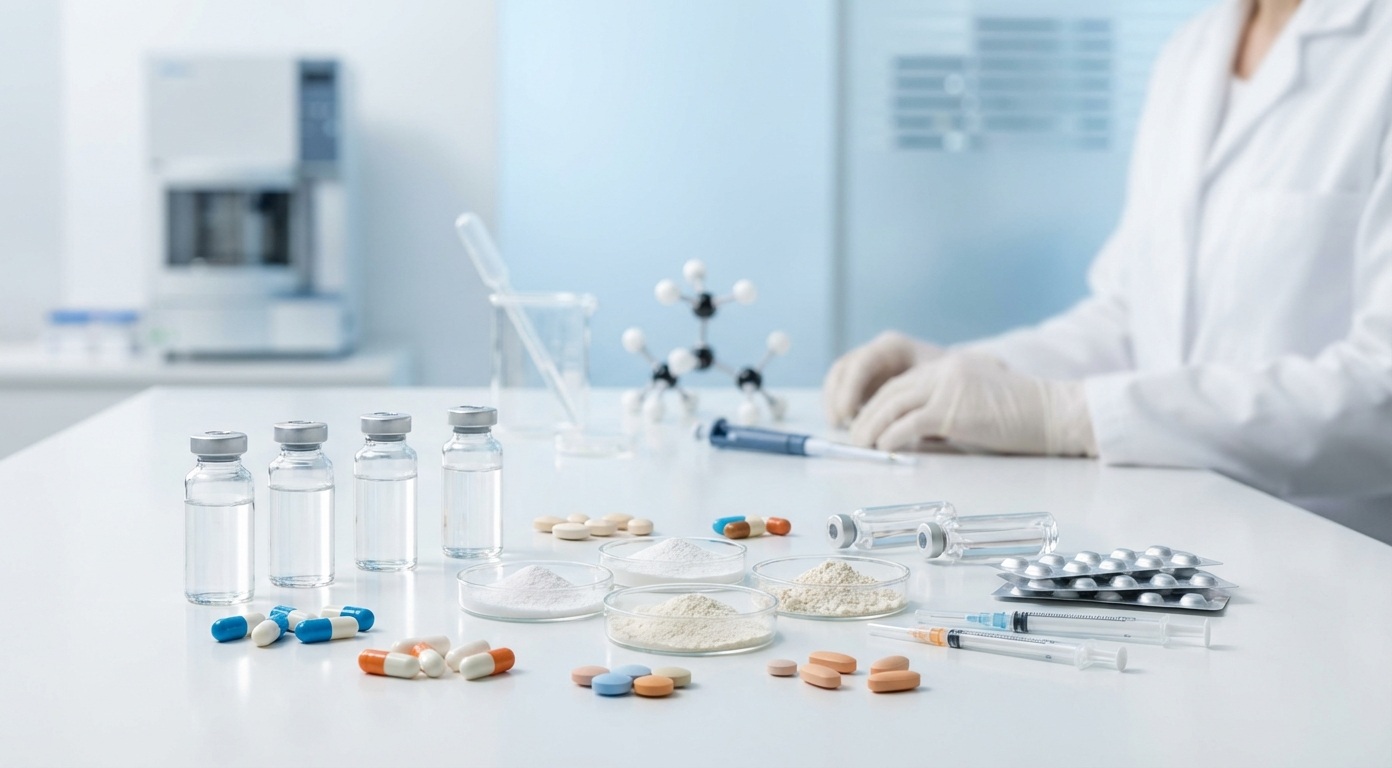
API: An essential, biologically active component found in a medication. It is a single active ingredient which interacts with your body’s systems to produce the desired pharmaceutical effect. Whether a drug treats an infection, reduces inflammation, controls blood pressure, or stops headaches, the API performs the essential therapeutic function in the background.
Drug Formulation: Like APIs, drug formulation is another crucial ingredient in the development of effective medications. Manufacturers prepare the finished drug product by combining the API with various excipients. Inactive compounds are another name for these “other substances.”
Overview of the API Manufacturing Process
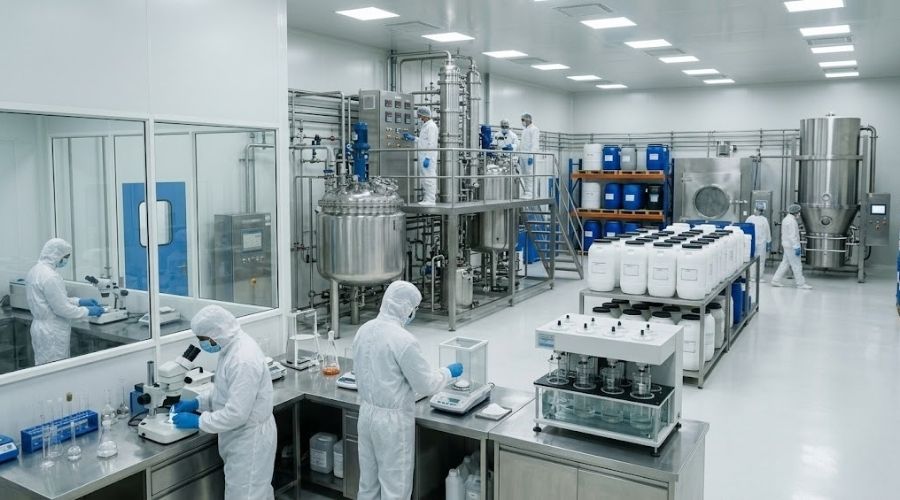
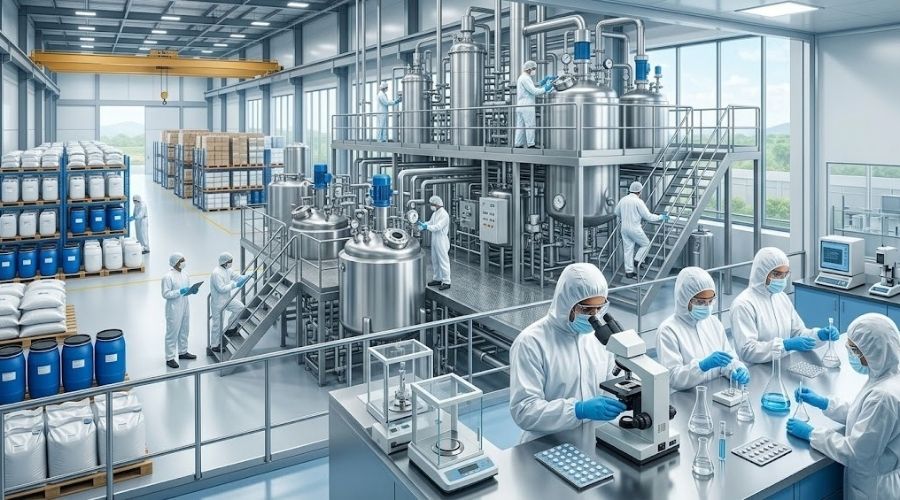
The pharma API manufacturing process is very highly delicate, technologically complex, and tightly regulated. It progresses through a number of series of well-coordinated phases, each with a specific purpose that enhances the final product’s quality. Before reaching formulation units, API synthesis involves chemical reactions, filtration, drying, milling, and quality testing.
Every stage, from the initial purchase of raw materials to the final packaging, is crucial to ensuring that the API meets international quality standards. It is clear from looking at each phase separately how much control and knowledge are required.
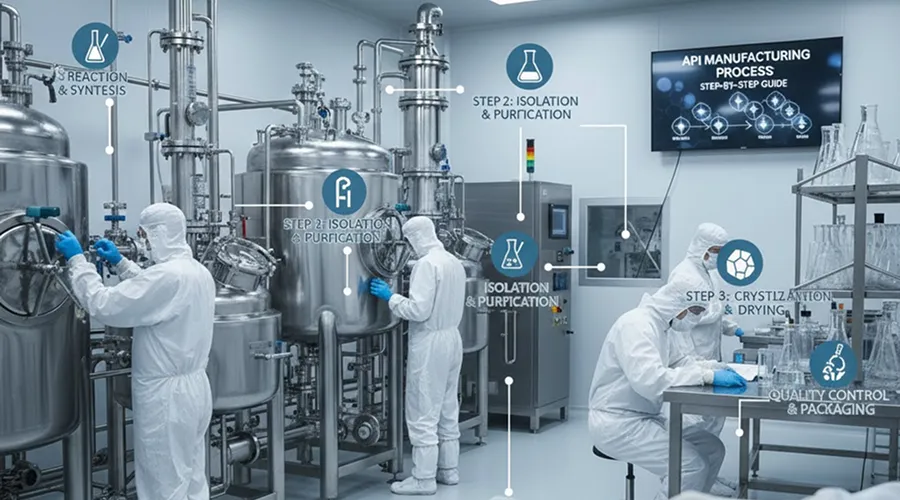
API Manufacturing Process Steps (Step-by-Step Guide)
The phases of the API manufacturing process are detailed below, demonstrating how APIs are created in a methodical, scientific manner.
Step 1: Raw Material Selection & Procurement:
No production method can outperform the quality of its raw materials. The choice of raw materials in API manufacture may significantly influence downstream processes, yield, and purity. Changes in stability, features, or impurity profiles may render the synthesis more difficult and/or change the final compound. Essential elements taken into account when choosing raw materials:
- Purity and regularity
- Reliability of the source
- Chemical stability
Step 2: Reaction/Synthesis Stage:
Chemical synthesis, which transforms raw materials into the required molecular entity, is at the heart of API production. Although the idea is straightforward, it isn’t easy to implement. The process of choosing the most effective, scalable, and sustainable route is known as route optimization.
Since it establishes the identification and essential characteristics of the final ingredient, this step is considered one of the most crucial in the pharma API manufacturing process.
Step 3: Purification (Crystallization/Filtration):
Purification is essential to the manufacturing process, regardless of how the API is made. Synthesis, fermentation, or extraction frequently produce contaminants and byproducts alongside the API. Manufacturers must eliminate these contaminants to ensure the API remains clean and safe for use in medications.
Step 4: Drying:
The API is often in a liquid or semi-solid state after it has been produced, extracted, and purified. Manufacturers must dry the API to create a powder suitable for medication formulation.
Manufacturers use different drying procedures depending on the API and its characteristics. They carry out this process under carefully monitored conditions to maintain the API’s chemical properties and ensure uniformity across batches.
Step 5: Milling & Particle Size Reduction:
To improve drug’s efficacy in the formulation, the API may also be ground to smaller particle size after drying. The API’s ability to dissolve readily, mix well with other formulation ingredients, and function well in the finished medication is influenced by particle size.
Step 6: Quality Control & Testing:
Quality control is one of the most crucial aspect of manufacturing APIs. Manufacturers must test each batch of API to ensure it meets the required purity, potency, safety, and quality specifications. It also involves all manner of testing (chemical analysis, physical testing such as particle size measurement, and, where necessary, biological testing, etc.).
Step 7: Packaging & Storage:
Finally, APIs are stored in a temperature-controlled environment and it is packaged in a tamper-proof, moisture-resistant container. Storage recommendations protect the API from oxidation, contamination, and deterioration. This final step completes the pharma API manufacturing process and prepares it for international shipping.
Importance of GMP & Quality Standards in API Manufacturing
Established organizations issue GMP manufacturing rules and guidelines to ensure the uniform quality of all pharmaceutical products. These rules focus on the goods and the facilities used to produce them.
APIs are in charge of the medication’s therapeutic impact. For API makers, following the GMP guidelines is therefore essential. By adhering to the GMP good manufacturing practices, manufacturers can also guarantee that every one of their APIs will:
- Possess a proper potency with purity.
- Lack of contamination.
- They are safe to eat.
- Fulfill the required standards for quality.
Every nation has its own GMP regulations. Thus, an API maker must comply with GMP regulations to export. WHO published the WHO-GMP, a good manufacturing practice guideline. These rules cover the raw materials, the manufacturing process, and the packaging of the medicine and API.
API Manufacturing in India — A Growing Global Hub
Active pharmaceutical ingredients (APIs) – the vital components that provide medicines with their medicinal properties are the very core of the pharmaceutical industry, the foundation of worldwide healthcare.
Although China, Europe, and the US have historically been the major producers of pharmaceuticals, India is today the world’s hub for low-cost API manufacturing.
India currently accounts for around 20% of the world’s generic drug exports by volume, thanks to its cost-effectiveness, highly qualified labor force, favorable regulations, and top-notch infrastructure.
The following elements contribute to the expansion of api production in India:
- An advanced chemical environment.
- Competent scientific staff.
- Strong R&D capacities.
- Sophisticated regulatory structure.
- Dedication to compliance with excellence.
Additionally, India contributes significantly to the global supply chain, particularly for vital medications such as cardiovascular, antiviral, and antibiotics.
Common Challenges in the API Manufacturing Process
Despite India’s dominant position in the global market, API manufacturers continue to face challenges. The following are some typical problems with the api manufacturing process:
Regulatory Compliance:
One significant potential challenge API manufacturers could face is regulatory compliance. As the pharmaceutical industry is highly regulated, API manufacturers may be required to comply with numerous rules and international standards, with noncompliance leading to fines, recalls, and reputational damage.
Complex Chemistry:
Complex chemical reactions and processes are often involved in the synthesis of the APIs. To ensure the manufacture of high-quality APIs, manufacturers need a detailed understanding of chemical reactions, under-reactions, and process development with control of impurities.
Supply Chain Management:
The prosperity of API manufacturing depends heavily on an efficient and reliable supply chain. Raw materials, solvents, reagents, and other necessary components and materials come from a network of suppliers, and disruptions to the supply chain risk delays in manufacturing and quality issues.
Quality Control and Assurance:
To ensure safety and the efficacy of drugs, a stringent baseline of standards is expected in the manufacture of APIs. Impurities, potency, and stability, among others, need to be constantly tested, monitored, and documented under the banner of quality control and assurance.
Environmental Sustainability:
As the production of APIs often involves significant amounts of chemicals and solvents, as well as time-consuming and energy-intensive procedures, the API production process can have a large ecological footprint. Some manufacturers respond to both governmental and consumer demands for environmentally friendly goods by adopting green chemistry principles, such as using cleaner solvents and reducing waste generated during manufacturing processes.
Conclusion
Decades of scientific advancement, the industrial expansion, and stringent quality standard have led to India’s ascent to the top of the world API production rankings. Indian businesses have developed processes that meet international standards by concentrating heavily on the entire production process. The methodical process from raw material selection to final packing guarantees safety, purity, and uniformity.
As the world’s reliance on Indian APIs grows, it is even more crucial to understand the manufacturing process, comprehend pharmaceutical formulation and APIs, and improve API manufacturing.
FAQs (Frequently Asked Questions)
What is API in pharmaceutical manufacturing?
API (Active Pharmaceutical Ingredient) is the core component in a drug responsible for its therapeutic effect.
What are the main steps in the API manufacturing process?
The process includes raw material selection, chemical synthesis, purification, crystallization, drying, and quality testing.
What raw materials are used in API manufacturing?
APIs are produced using chemical compounds, solvents, reagents, intermediates, and catalysts, depending on the drug type.
Why is quality control important in API manufacturing?
Quality control ensures the API meets purity, potency, and safety standards required by regulatory authorities.
What is the role of GMP in API manufacturing?
Good Manufacturing Practices (GMP) ensure APIs are consistently produced and controlled according to quality standards.
How long does the API manufacturing process take?
The timeline varies based on complexity, scale, and regulatory requirements, ranging from weeks to months.
Who regulates API manufacturing in India?
API manufacturing in India is regulated by CDSCO and follows guidelines from WHO-GMP, USFDA, and other global authorities.