If you are evaluating peptide manufacturing approaches or studying the SPPS method in peptide synthesis for the first time, you need a process guide that is accurate, not padded with claims that cannot be verified. This article walks you through every stage of solid phase peptide synthesis, starting from the steps, the chemistry behind them, the two main protection strategies, and how this technique is applied in modern drug development.
“The Fmoc/tBu strategy remains the most widely used approach in solid-phase peptide synthesis because it allows precise control under mild chemical conditions, which is critical for producing pharmaceutical-grade peptides without damaging sensitive side chains.”
What Is Solid Phase Peptide Synthesis?
Solid phase peptide synthesis is a method of building a peptide chain stepwise by attaching amino acids one at a time to an insoluble solid support, typically a polymer resin bead. Assembly proceeds from the C-terminus (carboxyl end) to the N-terminus (amino end). Robert Bruce Merrifield introduced this method in his 1963 paper in the Journal of the American Chemical Society which is still listed among the most cited papers in the journal’s history (Source).
For this work, Merrifield received the 1984 Nobel Prize in Chemistry “for his development of methodology for chemical synthesis on a solid matrix” (Source).
Think of it like threading beads onto a fixed string. The string stays anchored while you add one bead at a time. You control the order completely.
Steps in Solid Phase Peptide Synthesis
The steps in solid phase peptide synthesis follow a repeating cycle. Each pass through the cycle adds one amino acid residue to the growing chain. Here is how each stage works.
Step 1 – Anchoring the First Amino Acid to the Resin
The C-terminal amino acid in your target sequence is attached covalently to the solid support via its carboxyl group. Common supports include Wang resin, used when you need a free C-terminal carboxylic acid, and Rink amide resin, used when a C-terminal amide is required (Source). The resin is insoluble in all synthesis solvents, so it stays in place throughout.
Step 2 – Deprotection of the Amino Group
Every amino acid building block arrives with a temporary protecting group on its alpha-amino group, blocking it from reacting until the right moment. In this step, that protecting group is chemically removed, called deprotection. It is exposing the free amine for the next bond-forming step. In Fmoc chemistry, this is achieved by treatment with piperidine in DMF (Source).
Without this step, the synthesis cannot proceed selectively.
Step 3 – Coupling the Next Amino Acid
The next protected amino acid’s carboxyl group is activated using a coupling reagent. Commonly HBTU or HATU are the reagents that reacts with the deprotected amine on the resin-bound chain (Source). A new peptide bond forms. Excess reagents and byproducts are then washed away by filtration.
Step 4 – Repeating the Deprotection-Coupling Cycle
Here is the thing: this cycle consisting of the steps deprotect, wash, couple, and wash gets repeated for every amino acid in your sequence. Each full cycle adds exactly one residue. Washing between steps with solvents like DMF and DCM removes byproducts and prevents unwanted side reactions from accumulating (Source).
Step 5 – Cleavage and Final Deprotection
Once the full sequence is assembled, the peptide is cleaved from the resin using a cleavage reagent. In the Fmoc/tBu strategy, trifluoroacetic acid (TFA) simultaneously cleaves the peptide from the resin and removes all remaining side-chain tBu protecting groups. Under standard conditions of approximately 95% TFA, most common linker types like Wang and Rink amide, achieves complete cleavage within 30 to 90 minutes (Source).
Step 6 – Purification and Quality Analysis
Raw cleavage products contain truncated sequences and reagent residues. HPLC purification (high-performance liquid chromatography) separates the target peptide from impurities. Mass spectrometry then confirms the molecular weight and verifies sequence identity (Source).
Fmoc vs Boc: Protection Strategies in SPPS
Orthogonal protecting groups are central to solid-phase peptide synthesis. The concept is straightforward: two different protecting groups, each removable under different chemical conditions, without disturbing the other. The two main orthogonal protection schemes used today are Fmoc/tBu and Boc/Bzl.
Fmoc (9-fluorenylmethoxycarbonyl)is base-labile and gets removed with piperidine, a mild secondary amine base while the tBu (tert-butyl) side-chain groups are acid-labile and removed with TFA at the cleavage stage (Source).
No harsh reagents contact the growing peptide during synthesis. The Fmoc strategy is now the dominant approach and remains valid even decades after its adoption, thanks to continued development in reagents and automation (Source).
Boc (tert-butyloxycarbonyl) is acid-labile and requires repeated TFA treatments for each alpha-amino deprotection during synthesis, plus anhydrous hydrogen fluoride (HF) for the final global deprotection and cleavage step (Source). HF is a corrosive and toxic reagent that demands specialist safety infrastructure. Boc/Bzl chemistry retains value for specific applications where base sensitivity is a concern, but its use has significantly declined.
Worth knowing: the shift from Boc to Fmoc was driven precisely by the emergence of acid-labile linkers like Wang (1970) and Rink Amide (1987) . These release peptides cleanly under moderate TFA conditions (Source).
Advantages of Solid Phase Peptide Synthesis
The advantages of the SPPS technique over liquid phase peptide synthesis are substantial, and they explain why SPPS became the standard approach for the vast majority of synthetic peptide applications.
Speed and Efficiency
Because the growing peptide chain stays anchored to the resin, each coupling step can use a large excess of reagents, driving the reaction to completion efficiently. Repetition is possible without manual intermediate isolation at each stage.
Simplified Purification Through Filtration and Washing
Liquid phase synthesis requires isolating and purifying each intermediate after every coupling. In SPPS, excess reagents and byproducts are simply removed by filtration and washing between steps and no intermediate crystallisation required (Source).
Compatibility with Automation
Resin-based synthesis is fully compatible with automated peptide synthesizers. Automation removes human error, improves batch-to-batch reproducibility, and enables overnight synthesis runs without continuous operator involvement (Source).
Flexibility in Peptide Sequence Design
You can incorporate non-natural amino acids, D-amino acids, and chemically modified residues at any position in the sequence. This flexibility is important for designing peptides with properties that natural sequences cannot provide.
Limitations of SPPS and How They Are Addressed
No synthesis method is without constraints. Reliable SPPS typically handles sequences up to approximately 50 amino acid residues which are beyond that length, accumulated deletion sequences and truncations become difficult to manage. Difficult sequences, particularly those containing long hydrophobic stretches that can also undergo aggregation on the growing chain, physically blocking further coupling (Source).
Solvent use is also substantial. DMF and DCM are required in significant volumes and demand proper waste handling. For peptide targets that exceed the reliable SPPS length range, fragment condensation (assembling and ligating pre-synthesised segments in solution) and native chemical ligation are established strategies for extending accessible chain length.
Applications of Solid Phase Peptide Synthesis in Pharma and Biotech
Do you ever wonder how peptide-based drugs like GLP-1 receptor agonists reach clinical-grade purity at scale? SPPS is central to that process. Let us discuss the important applications of Solid Phase Peptide Synthesis:
- Therapeutic peptides, including GLP-1 analogues used in diabetes and obesity management, and antimicrobial peptides being evaluated across infectious disease research, are produced using solid phase methods.
- Beyond therapeutics, SPPS produces peptide antigens for vaccines and diagnostics and research-grade peptides for studying protein-protein interactions and validating drug targets.
- The precise control over sequence that SPPS offers allows researchers to test highly specific structural hypotheses.
GCCPL’s Vapi, Gujarat facility – operated through Eagle Chemical Works – manufactures APIs, minerals, and peptides under WHO-GMP-compliant conditions. For pharmaceutical companies sourcing peptide-relatedactive pharmaceutical ingredients or needing support with pharmaceutical intermediates that serve as building blocks in complex drug synthesis, GCCPL offers custom manufacturing with full international regulatory documentation.
Frequently Asked Questions About Solid Phase Peptide Synthesis
What is solid-phase peptide synthesis?
Solid phase peptide synthesis (SPPS) is a laboratory method for building synthetic peptides by attaching amino acids one at a time to an insoluble resin support. Developed by Robert Bruce Merrifield, whose1963 paper in the Journal of the American Chemical Society first described the method in detail, SPPS assembles the peptide chain stepwise from the C-terminus to the N-terminus. Merrifield received the Nobel Prize in Chemistry in 1984 for this work (Source).
What foods are high in peptides?
Foods naturally associated with bioactive peptides include bone broth, eggs, fish, and dairy products such as milk, all sources of collagen, casein, or whey-derived peptides. SPPS, by contrast, produces synthetic peptides designed specifically for pharmaceutical use, analytical reference standards, or laboratory research not for dietary consumption.
What are the 4 stages of protein synthesis?
Biological protein synthesis inside a living cell proceeds through four stages: transcription (DNA is copied into messenger RNA), RNA processing (the mRNA transcript is spliced and modified), translation (ribosomes read the mRNA and assemble the amino acid chain), and post-translational modification (the chain folds and may be cleaved or chemically modified). This is a cellular biological process. Solid phase peptide synthesis is a controlled chemical process carried out in a laboratory reactor, the two are fundamentally different in mechanism and purpose.
What equipment is needed for solid-phase peptide synthesis?
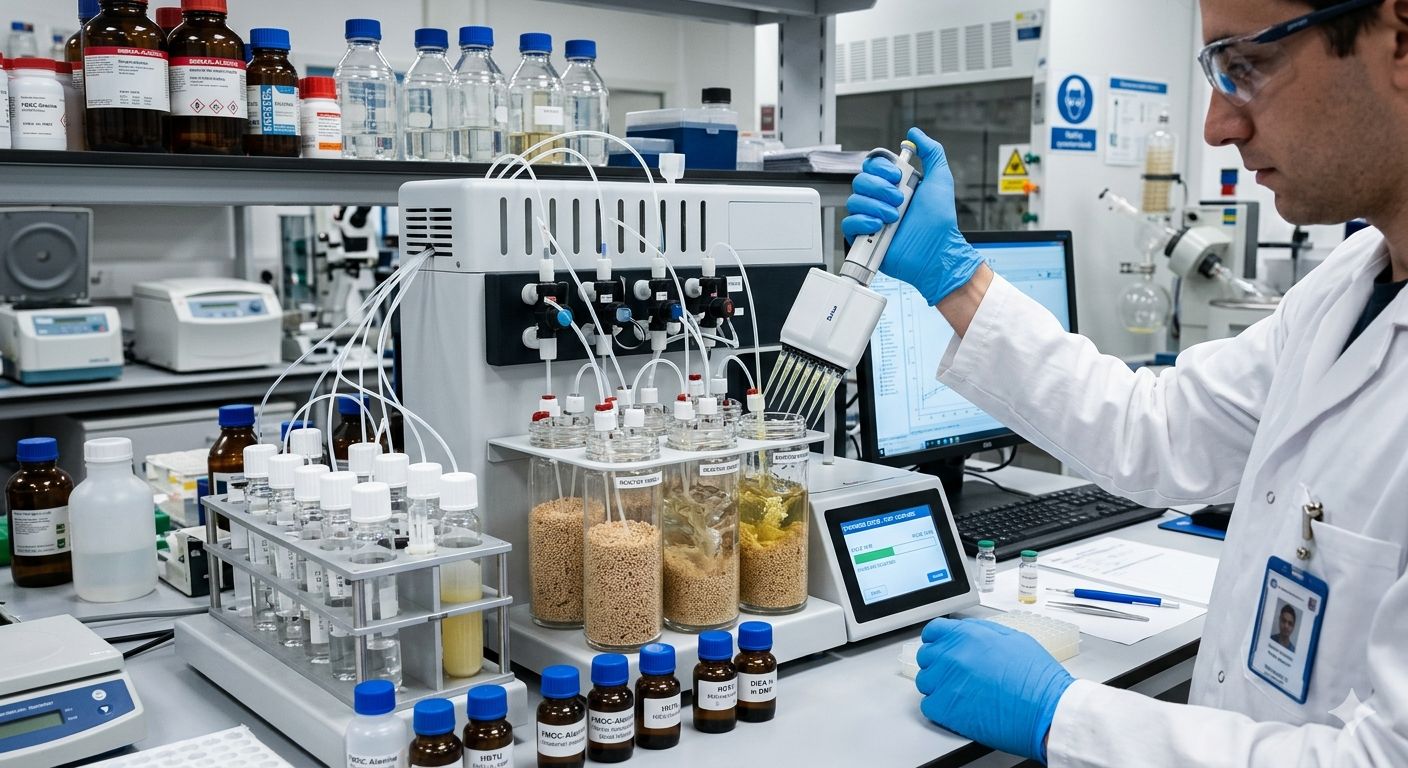
A complete SPPS setup requires:
- Automated peptide synthesizer (for reproducible, larger-scale batches)
- Reaction vessels with filtration hardware
- Resin support (Wang resin for peptide acids, Rink amide resin for peptide amides)
- Fmoc-protected amino acid building blocks
- Coupling reagents (HBTU, HATU, or DIC-based systems)
- Solvents: DMF (dimethylformamide) and DCM (dichloromethane)
- Cleavage reagent: TFA for Fmoc/tBu chemistry; HF for Boc chemistry
- HPLC system for purification of the crude peptide
- Mass spectrometer for identity and purity verification (Source) (Source)
Solid phase peptide synthesis gives researchers and manufacturers a reliable, automatable route to complex peptide sequences, from early-stage research tools to approved drug substances. Each step is chemically controlled.
Purification is streamlined by the resin-bound format. The Fmoc/tBu strategy covers the vast majority of applications under well-established, mild conditions. If you are planning a peptide synthesis project, your next step is to define your target sequence length and purity requirement, then consult a qualified synthesis provider such as GCCPL to determine the right scale and protection strategy for your application.