The pharmaceutical industry has entered an era where a single dose can cost more than a luxury home. Breakthrough therapies for rare genetic conditions now sit at the top of the cost ladder. According to a Reuters investigation, the median launch price for a new US drug reached around $300,000 in 2025, driven by rare disease treatments.
What makes today’s list different is the dominance of gene therapy. These one-time treatments target the root causes of devastating illnesses. Some therapies, like Lenmeldy, now cost over $4 million per dose, making them the most expensive medicines in the world in 2026.
Why Are Some Medicines So Expensive?
The medications are very expensive in this era because of the following reasons:
High R&D Costs
Bringing a single new drug to market can take more than a decade and cost upwards of $2.6 billion.
Rare Disease (Orphan Drug) Market
Many costly drugs treat conditions that affect only a few hundred patients globally each year. Companies must recoup investment from very few sales.
Advanced Technologies (Gene Therapy, Biologics)
Gene therapies use viral vectors, modified stem cells, or engineered T cells. Producing AAV vectors and editing patient cells requires highly specialized facilities.
Limited Patient Population
When only forty children a year in the United States are eligible for a treatment, every dose must carry a heavy share of the development burden.
Regulatory & Manufacturing Complexity
Each batch of a personalized cell therapy is custom-built. Strict pharma regulatory standards, quality control, and complex cold chain logistics push costs even higher.
Top 10 Most Expensive Medicines in the World (2026 List)
Below mentioned are the top 10 most expensive medicines in the world:
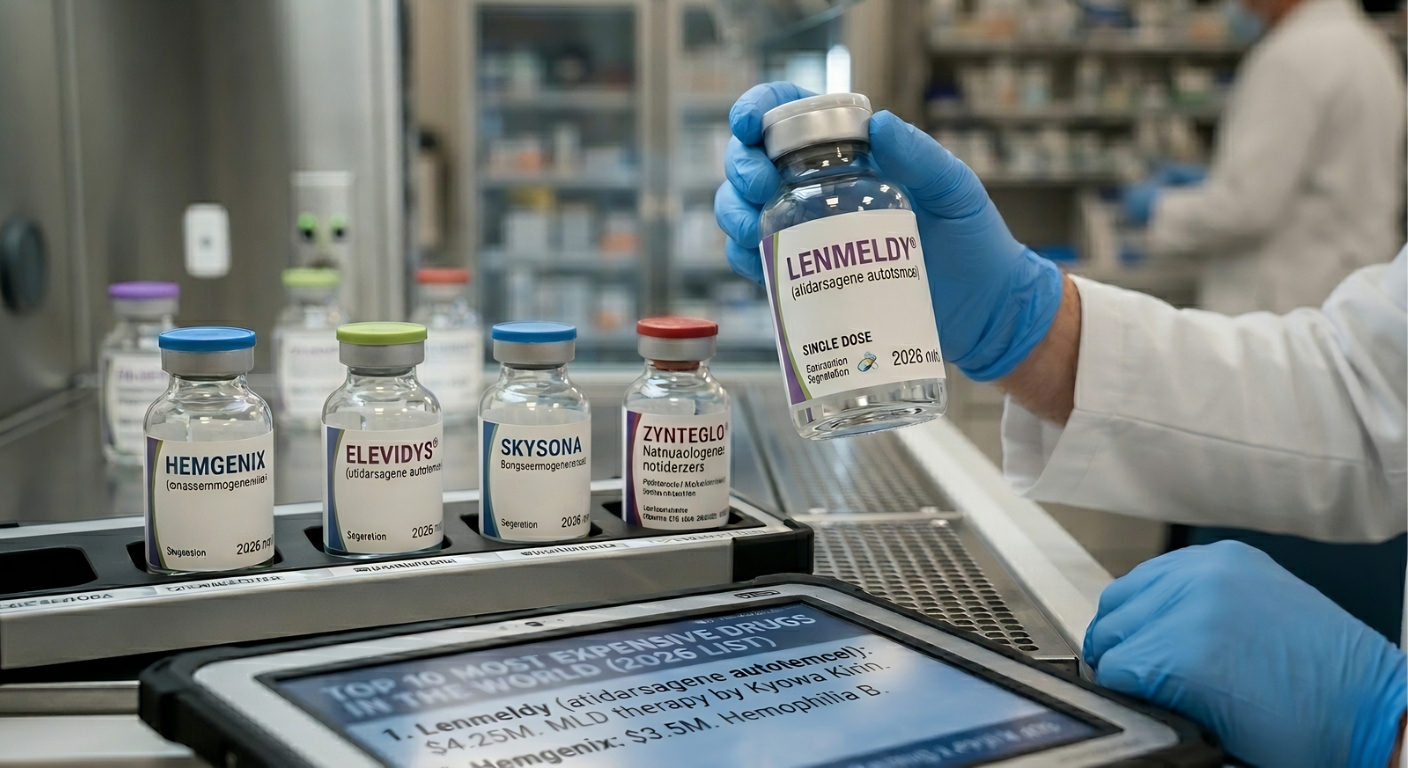
1. Lenmeldy: $4.25 Million
Lenmeldy (atidarsagene autotemcel) is currently the most expensive drug globally. Developed by Orchard Therapeutics, now a Kyowa Kirin subsidiary, it treats children with metachromatic leukodystrophy (MLD), a rare and fatal genetic nervous system disorder. The wholesale acquisition cost is set at $4.25 million per treatment.
2. Hemgenix: $3.5 Million
Hemgenix (etranacogene dezaparvovec) is a one-time gene therapy for adults with Hemophilia B, developed by CSL Behring and uniQure. Its $3.5 million price tag reflects the avoidance of decades of clotting factor prophylaxis. The Hemgenix cost reflects long-term savings in chronic care.
3. Elevidys: $3.2 Million
Elevidys (delandistrogene moxeparvovec), developed by Sarepta Therapeutics, is the first gene therapy approved for Duchenne muscular dystrophy. Priced at $3.2 million per single infusion, it targets a severe muscle-wasting disease in children.
4. Skysona: $3 Million
Skysona (elivaldogene autotemcel) is a gene therapy from Bluebird Bio (now Genetix Biotherapeutics) for cerebral adrenoleukodystrophy, a fatal childhood leukodystrophy. It costs about $3 million per treatment and is reserved for early-stage cases in young boys.
5. Zynteglo: $2.8 Million
Zynteglo (betibeglogene autotemcel), also from Bluebird Bio, is a one-time gene therapy for transfusion-dependent beta thalassemia. Priced at $2.8 million, it allows patients to produce normal hemoglobin and escape lifelong transfusions.
6. Libmeldy: $2.4M to $3.1M (Europe)
Libmeldy and Lenmeldy are the same gene therapy (atidarsagene autotemcel), branded differently. In Europe, prices range from around $2.4 million in Germany to $3.1 million in the UK. European pricing is generally lower than the US Lenmeldy price.
7. Zolgensma: $2.1 Million
Zolgensma (onasemnogene abeparvovec), developed by Novartis, is a one-time gene therapy for Spinal Muscular Atrophy in young children. With a list price of $2.1 million, Zolgensma is among the most discussed medicines worldwide. In India, where it is not locally manufactured, it must be imported and costs between INR 16 crore and INR 17 crore per dose, often funded through crowdfunding.
8. Myalept: $1.26 Million per Year
Myalept (metreleptin), now owned by Chiesi Farmaceutici, is a daily subcutaneous injection used to treat complications of leptin deficiency in patients with generalized lipodystrophy. At around $1.26 million per year and a single vial costing $5,867, it remains one of the highest-priced drugs globally.
9. Luxturna: $850,000
Luxturna (voretigene neparvovec), from Spark Therapeutics, was the first gene therapy approved in the US for an inherited disease. It treats biallelic RPE65-mediated inherited retinal dystrophy and costs about $850,000 for the two-eye treatment, remaining one of the top 10 most costly injections in the world.
10. Spinraza & Soliris ~ $750,000 First Year and ~ $470,000 Annually
Spinraza (nusinersen), from Biogen, is given into the spinal fluid for spinal muscular atrophy. It costs roughly $750,000 for the first year and $375,000 annually thereafter, requiring lifelong dosing. Soliris (eculizumab), originally from Alexion and now owned by AstraZeneca, treats paroxysmal nocturnal hemoglobinuria, atypical hemolytic uremic syndrome, and generalized myasthenia gravis. Its annual list price is around $470,000.
Key Trends in High-Cost Medicines in 2026
Several powerful trends shape the 2026 landscape. First, gene and cell therapies dominate the list, with most multi-million-dollar drugs being one-time treatments. Second, the industry is shifting from lifetime maintenance toward potentially curative interventions, raising upfront costs but reducing lifetime spending. Third, there is intense focus on rare diseases. Finally, pricing debates are growing globally as governments and patient advocates question whether these list prices are sustainable. Coverage of expensive gene therapy drugs continues to expand.
Challenges of Expensive Medicines
The challenges associated with the expensive medicines are:
Affordability Issues
Even in wealthy nations, very few families can pay millions out of pocket. The price of Soliris alone has prompted public debate in Canada, the UK, and Brazil about funding rare disease care.
Insurance & Reimbursement Challenges
Insurers face difficult choices when one patient’s therapy can equal annual premiums of thousands of plan members. Outcome-based agreements, in which manufacturers refund part of the cost if therapy fails, are becoming common.
Accessibility in Developing Countries
In countries like India, drugs such as Zolgensma are not locally approved, so families must import them at full price. The SMA injection cost can exceed INR 17 crore, leaving families dependent on crowdfunding.
Ethical Concerns
Researchers have noted that much of the basic science behind drugs like Soliris was funded by public money, raising questions about pricing.
How Governments & Pharma Are Addressing Pricing?
Governments and pharmaceutical companies are working on multiple fronts. In the United States, Medicare can now negotiate prices on a growing list of high-cost drugs. Value-based pricing models tie payments to clinical outcomes. Patient assistance programs run by manufacturers and nonprofits help eligible patients access medications at reduced or no cost. Many companies also offer multi-year payment plans.
Future of Drug Pricing in Pharma
Three forces will shape the road ahead. Personalized medicine will continue to grow, with more therapies designed for individual genetic profiles. Innovation in scalable AAV vector production and improved cell processing may reduce some costs. Regulatory frameworks are tightening worldwide, with stronger price negotiation expected.
The 10 most expensive medicines in the world represent both the promise and the challenge of modern medicine. They offer hope to patients with conditions once considered untreatable, yet their prices raise hard questions about access and sustainability. The central task is to balance breakthrough science with the responsibility to make these therapies reach patients who need them most
FAQs
What is the most expensive drug in the world in 2026?
Lenmeldy, priced at $4.25 million per one-time treatment, is currently the most expensive drug in the world. It treats children with metachromatic leukodystrophy.
Why do gene therapies cost so much?
Gene therapies are often one-time, individually manufactured treatments for ultra-rare diseases. Tiny patient populations, complex viral vector or stem cell production, and lengthy R&D timelines all push the price into the millions.
Are expensive drugs covered by insurance?
Many are, though coverage varies. Insurers often use value-based contracts that require prior authorization and proof of medical necessity. Patient assistance programs may also help cover out-of-pocket costs.
Which is the costliest injection in India?
Zolgensma is widely considered the costliest injection available to Indian patients. Imported from the United States, its price typically reaches INR 16 crore to INR 17 crore per dose.